
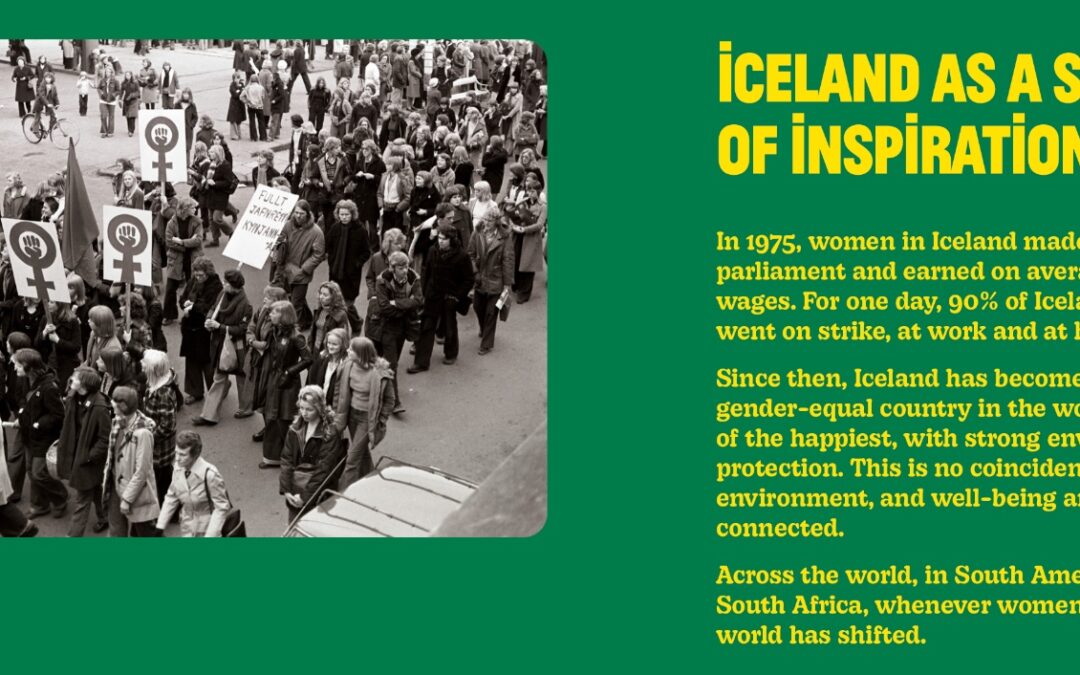
In an economic environment shaped by the need to attract new talent, changing workplace practices, and the drive to improve organizational performance, gender balance has become a strategic issue for businesses.
The World With Women movement, a global movement for gender balance, whose roots are in France, is part of this broader dynamic. A World With Women mobilization will take place on October 13, echoing October 24, the landmark date of the mobilization of Icelandic women. It reflects an international ambition: to advance gender balance across society, businesses, decision-making bodies, and professional ecosystems.
In this regard, Iceland’s experience offers particularly valuable inspiration. Iceland is regularly ranked among the countries with the strongest track records in gender equality. Beyond rankings, it provides a concrete example of how a society can turn a social issue into a driver of economic development, innovation, and attractiveness.
Iceland: A Laboratory for Gender Balance
Iceland has a particularly strong history of women’s participation in economic and social life. On October 24, 1975, Icelandic women mobilized on a massive scale by stopping paid work as well as a significant share of their domestic and family responsibilities. This mobilization highlighted, at the national level, the essential contribution women make to the functioning of society and the economy.
Since then, several generations of female business leaders, entrepreneurs, researchers, and public officials have helped transform perceptions. The young Republic has also introduced a range of measures designed to promote better representation of women within organizations and reduce professional disparities.
The value of the Icelandic model, however, does not lie solely in public policy or statistical results. It also reflects a collective culture that increasingly views work-life balance as a shared responsibility. This approach can support more flexible work organizations, improve talent retention, and encourage more balanced participation by women and men in economic activity.
From Equality to Economic Performance
For businesses, gender balance should not be viewed merely as a matter of compliance or corporate image. It can also be a driver of performance.
A more balanced organization can help to:
- expand the recruitment pool;
- strengthen employer attractiveness;
- diversify profiles and experiences;
- improve understanding of markets and customers;
- foster innovation and creativity;
- enhance the quality of decision-making;
- reduce the risks associated with an overly homogeneous culture.
In an economy such as Iceland’s, characterized by a limited domestic market and a strong international outlook, the ability to mobilize the full range of available skills is essential. Gender balance therefore becomes a matter of competitiveness.
The same logic applies to French businesses. In many sectors, including technology, industry, energy, finance, tourism, and scientific fields, employers need to attract and retain diverse talent. Making progress on gender balance is an effective way to respond to these skills shortages.
Iceland’s Contribution to the World With Women Movement
The relationship between Iceland’s experience and World With Women can be understood as one of inspiration and perspective rather than as a direct institutional relationship.
Iceland demonstrates that a society can bring about lasting change when gender balance is viewed as a shared responsibility. This experience contributes to an international conversation to which the World With Women movement is contributing from France: how can we move from principles to results? How can we make gender balance a reality in career paths, executive nellycommittees, entrepreneurship, and access to leadership positions?
The Icelandic model also reminds us that progress does not depend on a single measure. It results from a combination of complementary drivers:
- access to education and training;
- evolving management practices;
- the sharing of family responsibilities;
- transparent compensation and promotion criteria;
- the presence of female role models across economic sectors;
- the concrete commitment of business leaders;
- regular measurement of progress.
This approach is consistent with the purpose of World With Women: to create a cross-sector movement capable of bringing together businesses, professional networks, institutions, and citizens around a shared goal of gender balance.
Useful Lessons for French and Icelandic Businesses
Iceland’s experience can inspire several practical actions within companies.
First, measure. It is difficult to make progress without an accurate assessment of the current situation: the distribution of women and men by profession and level of responsibility, compensation, recruitment, promotions, and departures.
Second, strengthen talent pipelines. Gender balance is not achieved only at the top. It is built from education and training through recruitment, onboarding, and career development.
Third, review work practices. Working hours, meetings, telework arrangements, and evaluation criteria can have a direct impact on careers. More flexible and transparent rules generally benefit the entire workforce.
Fourth, hold management accountable. Gender balance objectives should be incorporated into corporate strategy and monitored like any other key performance indicator.
Finally, share experiences. Exchanges between French and Icelandic businesses can help identify solutions adapted to the realities of each market, without attempting to replicate a national model mechanically.
A Topic at the Heart of French-Icelandic Relations
French-Icelandic cooperation is not limited to commercial exchanges. It also relies on the circulation of ideas, skills, and business practices.
The French-Icelandic Chamber of Commerce and Industry (CCFRIS-AF) is committed to fostering these exchanges between the two economic ecosystems. Gender balance can serve as an additional area of dialogue among businesses, professional networks, and innovation stakeholders.
By bringing Iceland’s experience into conversation with the dynamic driven by World With Women in France, the CCFRIS-AF can help open a practical and non-political discussion about the future of work, leadership, and business performance.
Iceland brings a distinctive experience. France has its own initiatives and tools. Together, these approaches can help make gender balance a genuine competitive advantage for organizations.